AI Pirate Voice Generator: Create Authentic Pirate Voices
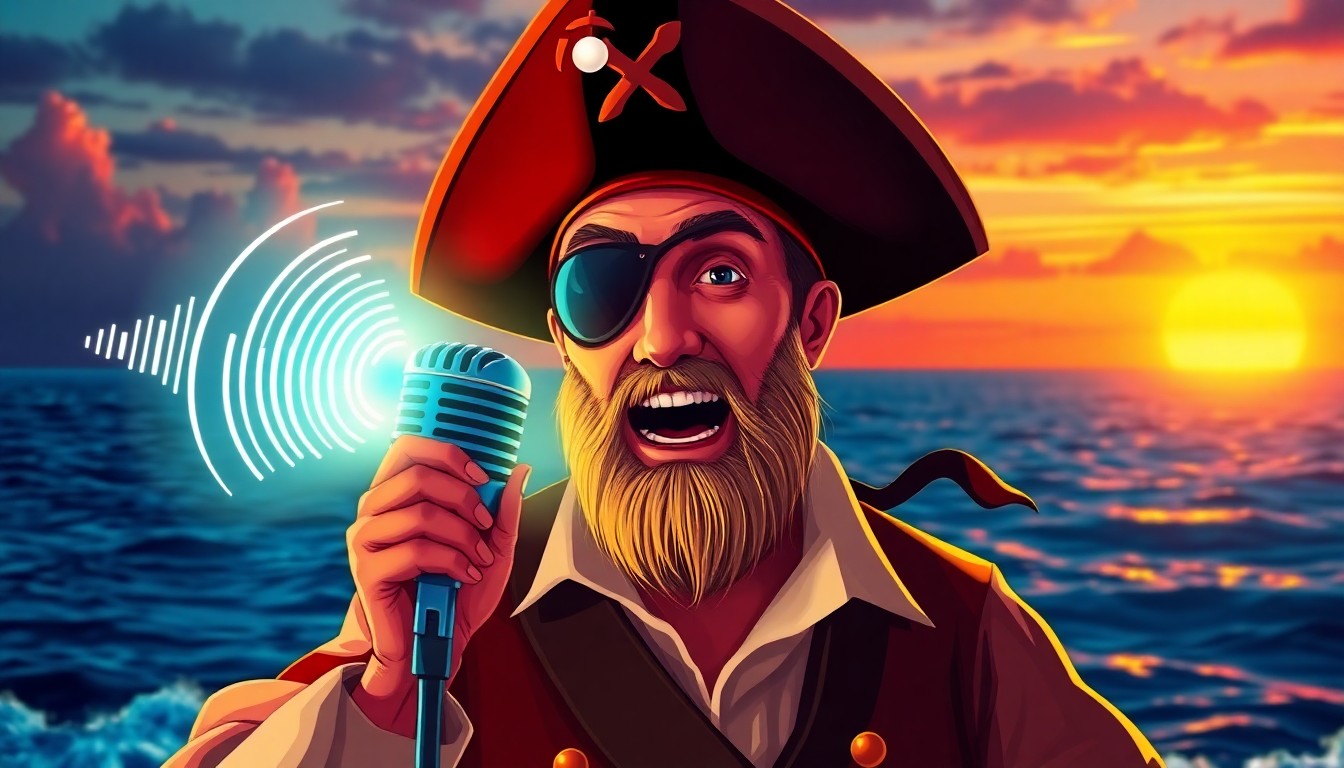
Pirate voices grab attention instantly. That gravelly "Arrr, matey!" cuts through the noise on TikTok, YouTube, and podcasts like nothing else. Content creators discovered this years ago. Now AI makes it accessible to everyone.
The challenge with pirate voices has always been consistency. You can do a decent impression for a few seconds. But maintaining that salty sea dog character through a full video? That takes skill most people don't have. AI voice generators solve this problem completely. Type your script, generate authentic pirate audio, download and use it however you want.
This guide covers everything you need to create professional pirate voiceovers. We'll explore which AI tools produce the most convincing pirate voices, how to write scripts that sound genuinely pirate, creative ways to use pirate AI voices in your content, and tips for making your pirate audio sound even more authentic through simple editing techniques.
Why pirate voices work so well for content
Pirate voices have something most character voices lack. Universal recognition. Everyone knows what a pirate sounds like. That rolling Rs, the theatrical delivery, the specific vocabulary. This familiarity means your audience gets the joke immediately without explanation.
The theatrical nature of pirate speech makes it perfect for AI generation. Pirates in movies and media speak with exaggerated emphasis and clear pronunciation. They pause dramatically. They growl certain words. These distinctive patterns give AI models clear signals to replicate.
The psychology behind pirate voice appeal
People respond to pirate voices because they trigger nostalgia and adventure simultaneously. We grew up with pirates in Disney movies, theme park rides, and Halloween costumes. The voice connects to childhood memories of treasure maps and wooden swords.
Pirate voices also carry inherent humor. Something about a pirate explaining cryptocurrency or reviewing fast food creates instant comedy. The contrast between the old-world character and modern topics generates laughs without trying hard. This makes pirate voices incredibly versatile for content creators.
The voice commands attention through its unusual cadence. Normal speech patterns get ignored. But when someone starts talking like a pirate, listeners snap to attention. This attention-grabbing quality makes pirate voices powerful for intros, calls to action, and key moments in your content.
Content types that benefit from pirate voices
Gaming content pairs naturally with pirate voices. Sea of Thieves, Assassin's Creed Black Flag, and dozens of other games feature pirates prominently. Commentary in a pirate voice adds entertainment value that straight narration can't match.
Educational content gets a massive engagement boost from pirate delivery. History lessons about actual pirates become infinitely more interesting when delivered by a pirate. Science explanations, language lessons, and even math tutorials gain personality through the voice.
Marketing and promotional content stands out when pirates deliver the message. A pirate announcing your sale or new product cuts through the endless scroll of boring ads. People stop because the voice is unusual. They stay because the content entertains them.
Podcast intros and outros gain memorability with pirate voices. "Ahoy, ye scallywags! Welcome aboard another episode..." instantly establishes personality and sets expectations for entertaining content.
Best AI voice generators for pirate voices
Not all AI voice platforms handle character voices equally. Some excel at realistic human voices but struggle with theatrical characters like pirates. Others nail the character work but produce audio that sounds obviously synthetic.
TryAIVoices for character voices
TryAIVoices offers a library of character voices specifically designed for content creators. The platform includes voices that capture theatrical delivery styles perfect for pirate content.
The movie character voices provide excellent starting points for pirate content. Characters like Darth Vader demonstrate the platform's ability to capture deep, commanding voices with dramatic delivery. This same technology applies to creating authoritative pirate captain voices.
For a more comedic approach, cartoon voices like Spongebob or Patrick Star show how the platform handles exaggerated character work. The enthusiasm and distinctive patterns translate well to creating energetic pirate characters.
Generation happens instantly without queue times. Input your pirate script, select a voice with the right characteristics, generate, and download. The workflow stays simple even when creating dozens of variations.
Choosing the right voice characteristics
The best pirate voices share specific qualities you should look for in any AI platform. Deep resonance provides the foundation. Pirates sound weathered by years at sea, which translates vocally to lower registers and rougher textures.
Theatrical delivery matters more than accent accuracy. Real historical pirates came from everywhere and spoke with various accents. Movie pirates created the standard we recognize today, and that standard emphasizes dramatic performance over geographical authenticity.
Look for voices with natural variation in pacing. Good pirate delivery speeds up during exciting moments and slows for dramatic emphasis. Monotone pirate voices fall flat regardless of how accurate the accent sounds.
Platform comparison for pirate content
Different platforms serve different needs in the pirate voice space. Free tools typically offer limited pirate options with noticeable quality issues. The voices sound robotic, lack emotional range, and produce audio artifacts that make content feel amateur.
Premium platforms like TryAIVoices provide consistent quality and variety. The ability to choose from 500+ voices means finding exactly the right pirate character for your specific content. A comedic pirate video needs different vocal qualities than a dramatic reading.
API access matters for creators producing high volumes of pirate content. Some platforms offer only manual generation through web interfaces. Others provide APIs that let you automate voice generation for efficiency.
How to write scripts that sound authentically pirate
The script determines 80% of your pirate voice quality. Even the best AI voice sounds wrong when reading text that doesn't match pirate speech patterns. Learning to write pirate dialogue transforms your results dramatically.
Essential pirate vocabulary
Pirates use specific words that immediately signal their character. "Ahoy" replaces hello. "Avast" means stop or pay attention. "Aye" substitutes for yes. Sprinkling these throughout your script creates instant authenticity.
Refer to people as "matey," "landlubber," "scallywag," or "ye scurvy dog." These terms of address establish the pirate world quickly. Use them naturally rather than forcing one into every sentence.
Replace common words with pirate equivalents. "Said" becomes "bellowed" or "growled." "Walked" becomes "swaggered" or "stumbled." "Looked" becomes "fixed me one good eye upon." These substitutions add flavor without requiring period-accurate vocabulary.
Speech pattern modifications
Pirates contract words differently than modern speakers. "You are" becomes "ye be." "It is" becomes "'tis." "My" often becomes "me" as in "me hearty" or "me treasure." These contractions sound natural in pirate speech even when they'd seem wrong elsewhere.
End statements with "I says" or "says I" occasionally. "That treasure be mine, says I!" This verbal quirk appears constantly in pirate fiction and signals the character immediately.
Add interjections generously. "Arrr!" works anywhere. "Shiver me timbers!" expresses surprise. "Blimey!" shows amazement. "By Davy Jones' locker!" adds dramatic weight to statements.
Script structure for pirate delivery
Open with a greeting that establishes the voice. "Ahoy there, ye landlubbers!" immediately tells listeners what they're getting. Don't bury the pirate character under normal introduction text.
Build in pauses for dramatic effect. Pirates speak theatrically, and theatrical speech needs breathing room. Write in ellipses or dashes where you want the AI to pause. "The treasure... it be cursed, matey."
End with a memorable pirate sign-off. "Now get ye gone before I make ye walk the plank!" or "Fair winds and following seas, me hearties!" These closings stick in listeners' minds and make your content more shareable.
Example script transformation
Original boring script: "Welcome to my channel. Today we're going to talk about the best restaurants in town. I've tried all of them and I'll share my honest opinions."
Pirate transformation: "Ahoy, ye hungry scallywags! Welcome aboard me channel, where we be huntin' the finest grub in all the land. I've sailed into every tavern in port and I'll be sharin' me honest thoughts, or me name isn't Captain Content. Now let's weigh anchor and set course for flavor, says I!"
The pirate version contains the same information but creates entertainment value through voice and character.
Creative ways to use pirate AI voices
The obvious pirate voice applications, Talk Like a Pirate Day videos and Halloween content, represent just the beginning. Creative creators find pirate voices useful year-round across diverse content types.
Comedy and entertainment content
Pirate voices excel at unexpected contexts. A pirate doing ASMR creates instant comedy. A pirate reviewing luxury products, giving relationship advice, or explaining technology generates humor through incongruity alone.
Duet content on TikTok works brilliantly with pirate voices. Take any trending video and add pirate commentary. The contrast between original content and pirate reaction creates shareable moments.
Gaming streams gain personality when you use pirate voices for specific characters or situations. Die in a game? Have your pirate voice curse your enemies. Find treasure? Let the pirate celebrate appropriately.
Educational content applications
History content benefits enormously from pirate delivery. Actual pirate history, the Golden Age of Piracy, famous pirates like Blackbeard and Anne Bonny, comes alive when told by a pirate voice.
Navigation and geography lessons connect naturally to pirate themes. Teaching about maps, ocean currents, wind patterns, and star navigation all tie to seafaring knowledge.
Literature content gains engagement through pirate voices. Reading passages from Treasure Island or explaining themes in pirate fiction becomes entertainment rather than lecture.
Business and marketing uses
Product announcements delivered by a pirate stand out in crowded feeds. "Ahoy! Our new product be here, and it'll change yer life, or me name isn't..." creates memorable marketing moments.
Sale announcements work perfectly with pirate urgency. "Avast! This treasure won't last forever! Sail into our store before the deals be gone to Davy Jones!"
Customer service holds and wait messages become entertaining with pirate voices. "Arrr, we be findin' the right person to help ye. Hold fast, matey, we'll be with ye shortly."
Podcast and audio content
Podcast intros establish personality instantly when delivered by pirates. Listeners know exactly what kind of show they're getting from the first "Ahoy!"
Transition segments between podcast topics work well with pirate voices. "Now we be sailin' into new waters, matey. Let's talk about..." guides listeners smoothly.
Ad reads delivered by pirates stick in listeners' minds better than standard delivery. Sponsors appreciate the memorability, and audiences find the ads less intrusive when they're entertaining.
Audio editing tips for better pirate voices
Raw AI-generated pirate voices sound good but benefit from simple post-processing. A few adjustments make your pirate content sound professional and polished.
Adding environmental atmosphere
Layer subtle ocean sounds beneath the voice. Gentle waves, distant seagulls, and creaking ship timber create immersive atmosphere. Keep these sounds quiet, around -20dB below the voice, so they enhance without distracting.
Occasional rope creaks and wooden groans add realism for content set on ships. Sound effect libraries offer nautical collections specifically for this purpose. One or two effects per minute maintains atmosphere without overwhelming.
Harbor ambience works for dock-side conversations. Distant voices, cargo being moved, bells, and water against hulls paint the scene sonically.
Enhancing vocal characteristics
Apply subtle distortion to roughen the voice slightly. Pirates sound weathered, not clean. A very light overdrive or saturation plugin adds grit without making the voice unintelligible.
Roll off some high frequencies above 8kHz to warm the voice. This simulates the effect of speaking through a thick beard while also reducing any digital artifacts in the AI generation.
Add light reverb with short decay to suggest an environment. Ship cabins, taverns, and caves all have distinct reverb characteristics that place the voice in a believable space.
Timing and pacing adjustments
Slow down dramatic moments slightly using your audio editor. When the pirate delivers important lines, a 10-15% slowdown adds weight and emphasis.
Add silence before key phrases. A half-second pause before "and that's when we found the treasure" creates anticipation that makes the payoff more satisfying.
Speed up long passages slightly if the AI delivered them slowly. Keeping energy high through quick editing maintains listener engagement for longer content.
Technical setup for pirate voice content
Creating professional pirate voice content requires proper technical workflow. The right setup saves time and produces better results consistently.
Recommended workflow
Start with your script written in a text document. Edit it thoroughly before generating any audio. Fixing script problems in text takes seconds while re-generating audio wastes time and credits.
Generate multiple takes of important lines. AI voices can vary slightly between generations, and having options lets you choose the best delivery for each moment.
Organize your audio files with clear naming conventions. "pirate_intro_v1.wav" and "pirate_intro_v2.wav" prevents confusion when you have dozens of generated clips.
Audio export settings
Export AI-generated audio at the highest quality available. You can always reduce quality later, but you can't add quality to a low-resolution file.
Use WAV format for editing work. WAV preserves full quality through multiple edits without degradation. Convert to MP3 only for final delivery when file size matters.
Match sample rates throughout your project. Mixing 44.1kHz and 48kHz audio causes subtle problems. Pick one standard and stick with it.
Integration with video editing
Import your pirate voice audio into video projects at full resolution. Let the video editor handle any necessary compression for final export.
Use audio keyframes to balance pirate voice with music and sound effects. Duck background audio during speech so the pirate voice stays clear.
Add visual elements that complement the audio. Pirate-themed graphics, ship footage, or character images reinforce the voice and create cohesive content.
Legal and ethical considerations
Using AI pirate voices involves some considerations worth understanding. Unlike celebrity voices that might raise legal issues, generic pirate voices generally avoid these problems entirely.
Why pirate voices are safer than celebrity voices
Generic pirate voices don't impersonate specific people. You're creating a character type rather than copying Johnny Depp's Captain Jack Sparrow or any other specific performance. This distinction matters legally.
Creating "a pirate character" differs fundamentally from creating "the Pirates of the Caribbean character." The former uses common cultural elements anyone can use. The latter potentially infringes Disney's intellectual property.
Voice type and speaking style aren't copyrightable. Anyone can speak with a pirate accent and use pirate vocabulary. The specific creative elements of a character performance are protected, not the general concept of "pirate voice."
Platform policies and disclosure
Social media platforms require disclosure of AI-generated content in some contexts. Check current policies for YouTube, TikTok, and other platforms where you'll publish your pirate voice content.
Disclosure doesn't hurt engagement for character voices. Audiences expect entertainment content to use effects and production techniques. Noting "pirate voice by AI" in your description satisfies requirements without undermining content.
Commercial use typically has fewer restrictions than voices impersonating real people. Using pirate AI voices for monetized content, brand videos, and paid projects generally falls within acceptable use policies.
Ethical content creation
Create content that entertains rather than deceives. Pirate voices work for comedy, education, and entertainment. Using them to mislead people crosses ethical lines regardless of legality.
Respect cultural contexts when using pirate themes. Actual historical piracy involved violence and crime. Comedic pirate content differs from content that glorifies harmful actions.
Credit your tools when appropriate. Mentioning TryAIVoices or other platforms in descriptions helps other creators discover useful resources.
Common mistakes to avoid
New creators making pirate voice content often fall into predictable traps. Avoiding these mistakes puts you ahead of most competition immediately.
Script problems that ruin pirate voices
Inconsistent pirate language breaks immersion. If your pirate says "Ahoy, matey!" in one sentence and "Hello, everyone!" in the next, the character falls apart. Maintain pirate vocabulary throughout or don't use it at all.
Over-explaining pirate terms kills pacing. Don't write "Ahoy, which means hello in pirate speak." Your audience knows what ahoy means. Trust them.
Modern slang in pirate mouths sounds wrong. Pirates don't say "that's cap" or "no way, bestie." Keep vocabulary appropriate to the character even when discussing modern topics.
Technical mistakes
Choosing the wrong base voice undermines everything. A high-pitched, soft voice can't sound like a grizzled pirate captain no matter how good your script is. Match voice characteristics to your intended character.
Generating audio at low quality to save time costs more time later. Re-generating better quality versions when you realize the quality isn't acceptable doubles your work.
Ignoring audio levels creates amateur results. Pirate voices need to sit properly in your mix, not blow out speakers during loud moments or disappear during quiet ones.
Content strategy mistakes
Making all your content pirate-themed limits your audience. Pirate voices work best as variety within a broader content strategy. Occasional pirate content surprises and delights. Constant pirate content exhausts audiences.
Ignoring trending topics because they don't seem pirate-related misses opportunities. Almost any topic can get pirate treatment. News, sports, entertainment, technology. Everything becomes more entertaining with unexpected pirate commentary.
Forgetting calls to action because you're focused on the voice wastes traffic. Your pirate can absolutely say "Smash that subscribe button or walk the plank, ye scallywag!" Character voices make CTAs more effective, not less.
Building a pirate content strategy
Successful creators don't just make random pirate content. They build strategies that use pirate voices effectively within larger content plans.
Content calendar integration
Plan pirate content around relevant dates. Talk Like a Pirate Day in September is obvious, but pirates also fit Halloween, summer beach content, and adventure movie releases.
Mix pirate content with your regular content types. If you normally make tech reviews, occasional pirate tech reviews provide variety. If you make cooking content, pirate recipe narration adds entertainment value.
Batch create pirate content for efficiency. Generate multiple pirate voice clips in one session while you're in the workflow. Having inventory lets you post consistently without constant creation pressure.
Audience building with character voices
Pirate content often gets shared more than standard content. The novelty encourages people to send it to friends. This sharing drives discovery and audience growth.
Consistency in your pirate character builds recognition. If you create a specific pirate persona with a name and backstory, audiences remember and request more content with that character.
Engage with comments in character occasionally. Responding to YouTube comments as your pirate character extends the entertainment and strengthens audience connection.
Monetization opportunities
Brands pay premiums for memorable content. Pirate voices create memorable content. This combination opens sponsorship opportunities that generic content doesn't attract.
Product creators can use pirate voices for promotional material. Selling digital products, courses, or services? Pirate voices for ads and promos help you stand out in competitive markets.
Patreon and membership content benefits from exclusive character content. Offer patrons special pirate episodes or behind-the-scenes content featuring your pirate character.
Frequently asked questions
Can I use pirate AI voices for commercial content?
Yes. Generic pirate voices don't infringe on anyone's intellectual property. You're creating a character type, not copying a specific copyrighted character. Commercial use for monetized videos, brand content, and marketing is generally acceptable. Always check the specific terms of whatever AI platform you use.
What makes a pirate voice sound authentic?
Authentic pirate voices combine several elements. Deep, slightly rough vocal quality provides the foundation. Theatrical delivery with dramatic pauses creates the performance. Pirate vocabulary including "ahoy," "matey," "ye," and "arrr" signals the character. Rolling Rs and emphasized consonants complete the sound.
How long should pirate voice content be?
Length depends on your platform and content type. TikTok pirate content works best at 15-60 seconds for maximum engagement. YouTube pirate content can run longer, but keep the pirate voice portions punchy. Full-length pirate narration works for storytelling content but exhausts listeners if every word comes in character.
Can I create different pirate characters with AI?
Absolutely. Different base voices create different pirate characters. A deep voice becomes a grizzled captain. A higher voice becomes a young cabin boy. Varying the script style further differentiates characters. Serious pirates, comedic pirates, and villainous pirates all require different writing approaches.
How do I make pirate voices work with music?
Balance is key. Duck background music when the pirate speaks so words stay clear. Choose music that fits the pirate theme, sea shanties, epic orchestral tracks, or Caribbean-inspired sounds. Let music fill between speaking segments to maintain energy and atmosphere.
Related voices to try
- Darth Vader for deep, commanding character work
- Morgan Freeman for authoritative narration
- Ghostface for dramatic character voices
Related guides
Pirate AI voices open creative possibilities that didn't exist a few years ago. Anyone can now create professional-quality pirate content without voice acting training or expensive studio sessions. The technology handles the hard part while you focus on creativity and entertainment.
Start simple. Write a short pirate script. Generate the audio with TryAIVoices or another quality platform. See how your audience responds. Most creators find pirate content outperforms their expectations.
The key is treating pirate voices as tools for entertainment rather than gimmicks. Good scripts, proper editing, and strategic use create content that genuinely delights audiences. Bad scripts and overuse create content that annoys. Choose entertainment over gimmick, and your pirate content will serve you well.
Now get ye to creating, ye scallywag. The seas of content await, and fortune favors the bold.